Bootstraps Are Bullsh*t. Make It Easy.
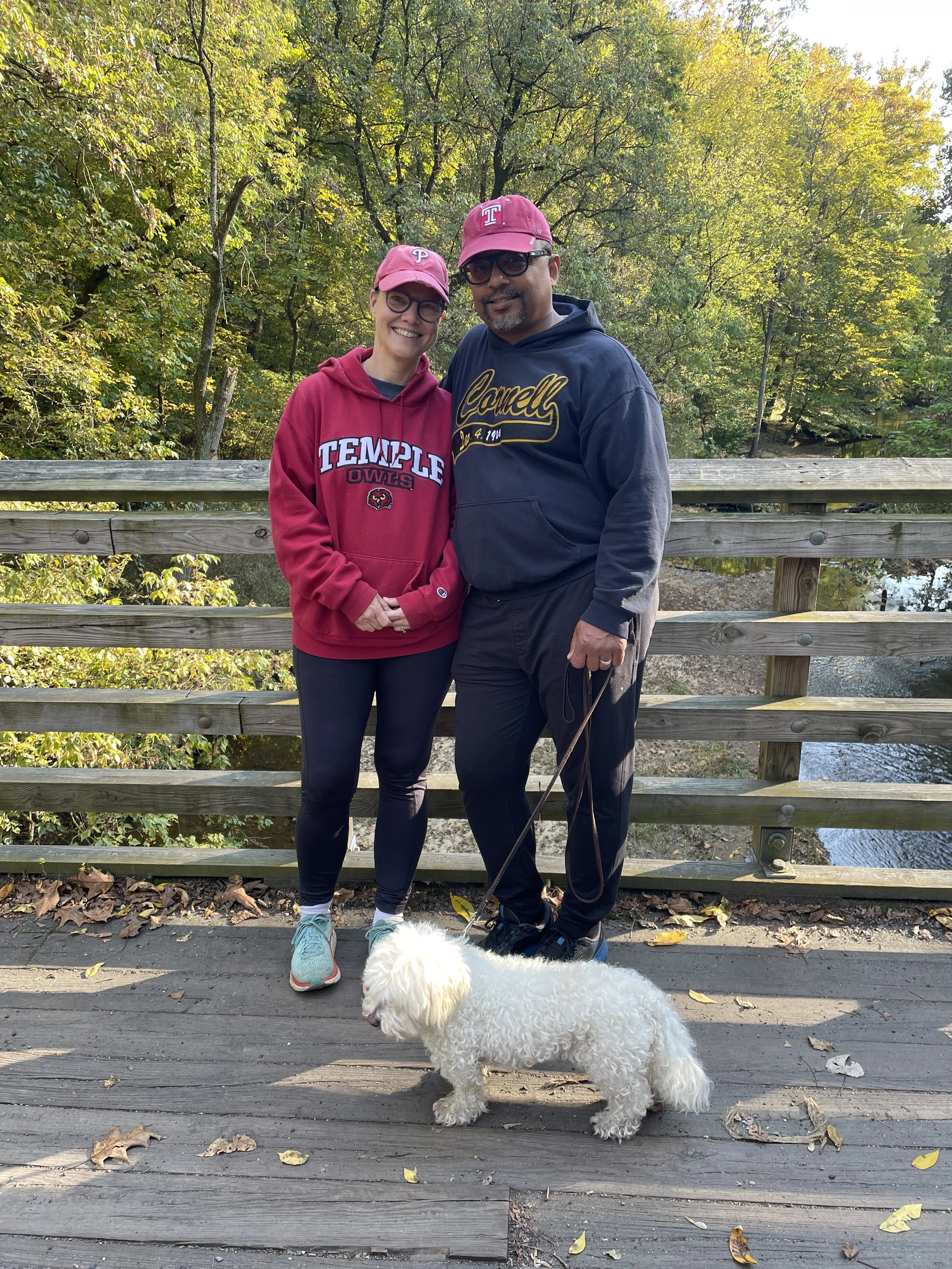
Exercise is easy when I do it outdoors with someone I love!
Hello Courageous Thrivers,
A tip for a Joyful January (yes, even now, especially now), and beyond: Make it easy.
It’s true, as Glennon Doyle says, “We can do hard things.” And some of us need to be reminded of that because we have a tendency to fall apart or avoid challenges.
But also.
Much of the time, we can choose to make it easy.
The idea that we can do important work, or make big changes in our lives with ease pushes up against a lot of cultural myths here in the U.S., especially the one about the “self-made man” or woman or gender non-conforming human. Though let’s be honest, it’s still usually a man.
You know the story. The independent success who pulled himself up by his own bootstraps with no help whatsoever. Except for the wife at home who handled the cooking, cleaning, and childcare. Or the Lone Ranger who saves the nation. Except that he actually wasn’t “lone,” and his trusty sidekick was an Indigenous person whose land was being stolen and whose people were being killed by cowboys and others.
Are these really the examples you want to follow?
Do they align with your values and your life situation?
The Myth of Bootstraps and Going It Alone
When we idolize the “no pain, no gain” and “just do it” types who never make excuses and always follow through, many of us start to believe we are broken or undisciplined.
But more and more research is showing that we’re wrong.
More often than not, people who reach their goals do so because they made it easy for themselves. Not because they are extra gifted at doing hard things.
Successful people tend to work with their natural tendencies and preferences, rather than fighting them.
Author Gretchen Rubin, for example, found that people fall into different categories when it comes to how we respond to expectations. Not many of us are “Upholders,” the people who easily meet both inner and outer expectations. Some of us are Rebels, so as soon as we make a rule for ourselves, we want to break it. Many of us are Obligers, who find it easiest to meet the expectations of others.
She found that if you ignore your tendency, you are much more likely to fail.
Why Making It Easy Actually Works
Successful people create systems that make the behavior they want to practice the default, rather than something that requires constant decision-making or willpower.
If you meet a friend you love at the gym every Tuesday night, it’s easier to go than to skip it.
If Saturday morning is budget time and it includes a trip to a favorite coffee shop, it can become easier to do it than not.
Most successful people also gather other humans around them who support them in moving towards their goals. Sometimes those are paid helpers like coaches, therapists, or personal trainers. Sometimes they are friends or family. But the idea that truly successful people always go it alone is a myth. They have PEOPLE.
When we define “success” to include relationships, health, and joy, not just visible work-related achievements, we see another pattern.
Successful people practice self-compassion and curiosity when they get stuck, instead of judgment. Instead of repeating the tired story of, “This isn’t that hard, why can’t I just get it together,” they ask, “Hmm, what’s going on here? What else might I try?” And then they try something else.
They also choose goals they genuinely want, rather than goals built out of “shoulds.” It is much easier to keep moving forward when the desire is emotionally compelling.
Making Change Kinder and More Human
I can tell you from my own life and from my work with clients that these more compassionate, easier methods really do work. And as a bonus, they tend to bring more joy along the way. Not just when we reach the goal, but as we’re moving toward it. We actually pause long enough to let the wins land.
In fact, I’ve been learning from Ali Shapiro, creator of Truce with Food, that research shows that as adults we generally need to see results quickly in order to stick with them. So the HOW of making change matters.
But don’t take my word for it. Try it yourself.
Here’s an example from a client, shared with permission.
She is a busy, deeply dedicated mom with a full-time job. She has a teen son who is a star athlete with a packed schedule, a husband with a demanding job, and about a 40-minute commute tied to school and work. Her son isn’t old enough to drive yet.
As part of her commitment to discovering what she loves and going after it, she wanted to start a meditation practice. But she kept not doing it.
Here’s what helped.
She shrank her goal for the week from “I will meditate five days” to “I will meditate once for ten minutes.” Easy wins have their own motivating energy.
She downloaded an app that structured the meditation for her, so no decisions were needed once she sat down.
She and her husband renegotiated driving responsibilities, which freed up a small window of time two mornings and one afternoon a week. Guess what she did with her extra thirty minutes one afternoon? Yup. Meditation. Done.
She also allowed herself to pick up food on the way home instead of cooking one night, which relieved the pressure that usually pulled her straight into meal prep. That gave her the freedom to go upstairs and meditate again. Bonus round. Done.
She will also tell you that investing in a life coach helped. Support, accountability, and a place to work through fears made a difference. I might be just the support you need - especially if you’re trying to figure out how to show up for justice and the safety of all humans when you’re afraid and exhausted. But that support can come in many forms.
The important thing is this: please don’t believe the lie that you’re supposed to be strong enough to do it all the hard way. And all alone.
Make it easy.
Here’s to THRIVING and equity, joy and justice,
Deb
Reflection:
Why does making things easier feel like cheating or weakness?
This is such a good question and the answer won’t be the same for everyone, but my short answer is that you’ve been taught exactly that!
One clear place of influence are messages we get constantly that indicate that nothing good comes easily. We see this idea in common phrases that get thrown around like “no pain. no gain.” Of course there are times when gain requires some pain. When we strengthen muscles they can feel sore for awhile. But making that into an absolute truth turns it into a lie. Sometimes gain comes through relaxing and playing more, so creative ideas can flow. Sometimes the courage to say the scary thing comes because we have layered in all kinds of supports.
Think about how people say that something like faith in God or therapy is a “crutch.” Umm. Why is that a problem? If I have a broken leg I need a crutch. It’s doing an important job. And I don’t know anyone who has ever been on crutches who doesn’t get rid of them as soon as they can walk without them. They aren’t exactly fun to use. So when you need a crutch, use it. Maybe at some point you won’t need it any more. Maybe you’ll have a permanent need for it. Who cares if it helps you to do what matters to you most?
Why does my body just have SO. MUCH. RESISTANCE?
Usually when our bodies, or minds, powerfully resist a change, it’s because some unconscious part doesn’t think that change is safe. So my first recommendation is that you do the best you can not to get in a fight with the resistance. Instead, relax, stop pushing and assume that the resistance isn’t working against you. Assume it’s a good and wise part of you that’s just mistaken about how it can help.
If you know how, or have access to a therapist who does IFS or somatic work, you may want to explore what message it has for you, but you don’t necessarily have to know the why or dive into the depths of your psyche to get unstuck.
A second way to approach this challenge is by choosing SLOW and TINY steps, like my client did in the story above. Are you resistant to meditating for 30 mins? How about 15? Still feel resistant? How about 5? Still a no? Try 1 minute.
This also works with social justice actions. Are you afraid to call your representatives? Could you email? Feel like you should go to a protest but that feels way to hard, can you reach out to your Mexican cleaning lady and offer to drive her or any of her friends to the store or school if they start feeling afraid? Still too hard? Can you look up and immigrant rights org in your town and make a donation?
Make it easy enough that you can do it. Then celebrate yourself with a “Yes! I did it!” fist pump (or something else) while you turn down the volume on the “but it really wasn’t enough” voices - and remind yourself that this is just an experiment.
You can always go back to beating yourself up and/or forcing yourself to do stuff you really really don’t want to do if this approachdoesn’t work out for you.
When I create ease, I feel so guilty, especially when other people have so many more challenges than me.
This is such a common one for people who have an awareness of the privileges they have. I fall into this trap often myself.
And there are times when we get stuck in cycles of self-care that never seem to work well enough to move us into action - especially people who have enough resources to keep going more retreats, seeing more healers and chasing the illusive dream of feeling “ready” to show up for others. I’ve been that person too.
The key is to look at the results of this line of thinking/feeling.
When you have the thought “I shouldn’t get to experience ease when others have so many more challenges than me,” what do you do? And does what you do help those people that you’re concerned about?
Speaking for myself when I’m stuck in that place I tend to use a lot of energy combatting the critical thoughts in my head. I feel less able and more afraid to take action.
Other people may start doing all kinds of random actions frantically, which also doesn’t generally lead to actual positive change.
Conversely, what happens if you experiment with creating just a little bit of ease? Like my client did when she bought dinner instead of doing the “more right” thing and cooking it. Viola, she was able to meditate.
Some social justice examples might be feeling afraid to go to a protest and calling a friend to go with you - adding ease. Or getting on Zoom with a friend and writing emails to your representatives together. Or signing a petition from MoveOn, but not requiring yourself to share it on Facebook like they always ask you to do.
**A free resource for doing this kind of thought-work on your own is Byron Katies’ “The Work,” but again, most of us do better with human to human support, at least at first.
***A low-cost way for you to get more human support is to join as a paid member of Controversial Grace over on Subtack. We have a monthly grace gathering and the first one is on Feb. 2, 2026
****Or if you’re one of those people who has ample resources and you want help to get out of the “I-need-more-help-and healing-before-I-take-any-courageous-action” trap. I know this one well and I’d love to help. It’s amazing how healing it is to do the both/and - lean into lots of support AND take the actions that are ours to take.